America’s Largest Enterprises in 2025
Tellusant’s third official America’s Largest Enterprises Ranking in the Twenties (ALERT) is out. It ranks the largest U.S. companies by value-added (VA)—economist’s preferred way to measure size—and a better method than ranking by revenue like Fortune does.
Amazon maintains its lead at the top in 2025 and is the clear no. 1.
We start by presenting the results, which is what most people are interested in. After this follow definitions and methods.
America’s Largest Enterprises
The ALERT list for 2025 is shown in the graph below. Companies are ranked by value-added (VA). We also show the position change from previous year (Δ24-25), and the ratio of VA to revenue, which we call density.
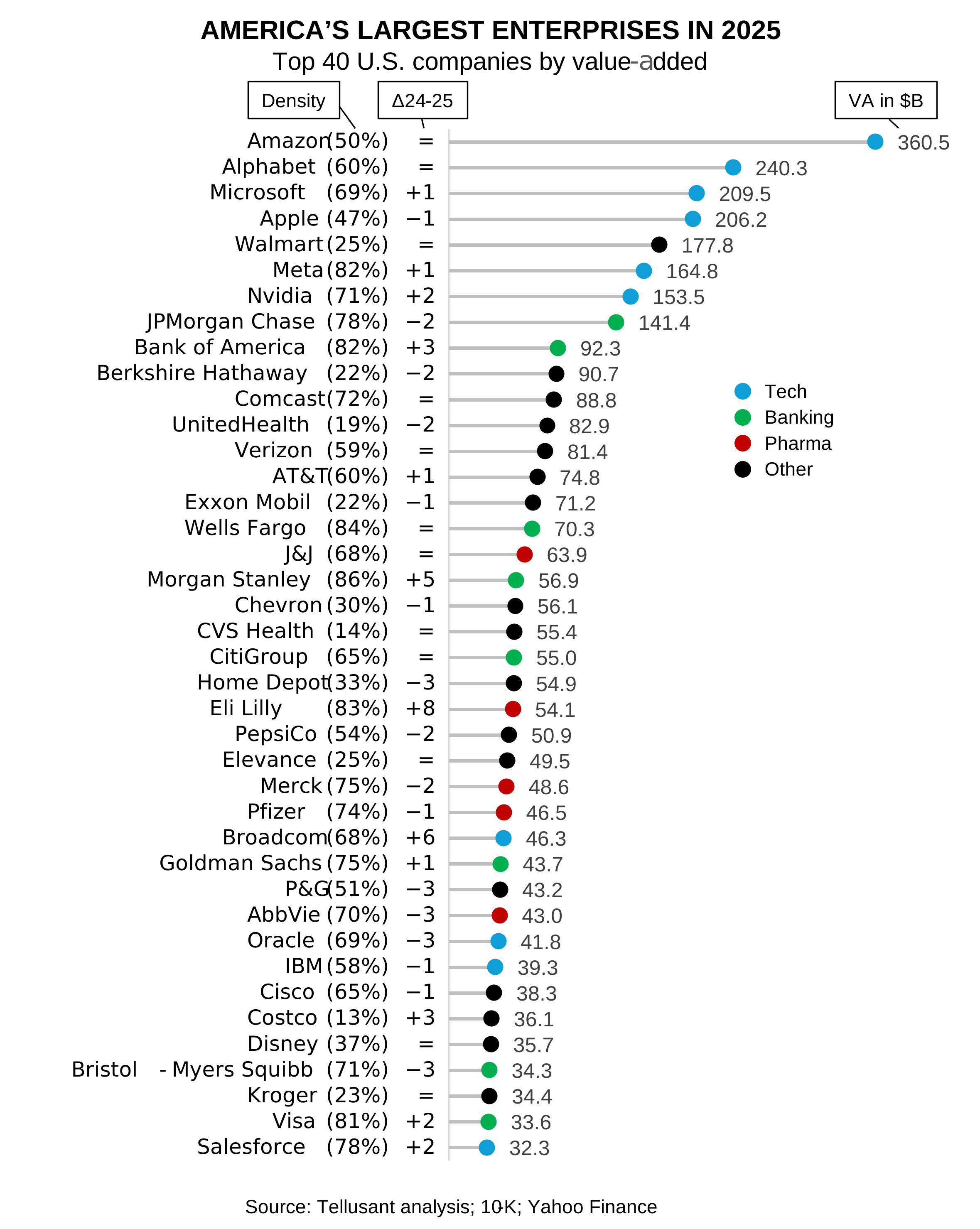
Note that it is neither good nor bad to be large from a performance perspective. Having high or low density has no impact on performance either. Our list is only for informational purposes.
What jumps out from the analysis? We see a few themes:
The Tech Juggernaut
The U.S., with China, have by far the most vibrant tech sectors in the world. Many countries have entrepreneurs and startups, but only the U.S. has managed to scale a few such companies to become 6 out of the top 10. Meta was founded 21 years before the 2025 list. Alphabet a few years earlier.
This success is not self-made by the younger companies. They stand on the shoulders of earlier giants like Hewlett-Packard, IBM, and Microsoft (still in the race), Intel, or Texas Instruments.
The Top
Amazon has the honor of being the largest company in 2025 as it has been for a few years. Note that Amazon changed its accounting practice in 2024. Before this change, it was no. 5. We believe the new accounting practice reflects reality better.
Alphabet is a solid no. 2. Few know that Alphabet is such a behemoth. Large, yes, but the second largest? Revenue rankings deceive (no. 7).
Microsoft passed Apple to reach no. 3. Cloud solutions and data centers are the main reasons.
Apple is somewhat stagnant in 2025 and dropped to no. 4.
Walmart has surprising longevity. That a retailer can be in the top five is remarkable. On the one hand, it still has growth opportunities in the U.S. (e-commerce and more). On the other hand, it has succeeded in building a position globally.
Meta is holding up well. Social media may be in decline, but Meta’s ability to monetize its user base is astonishing. It is one a few companies that appear to apply AI at scale.
Nvidia continuous to show extraordinary growth and profitability based on AI chips. Nothing like it has ever been seen. It reached the no. 7 spot in 2025 (no. 9 in 2024, no. 22 in 2023, no. 79 in 2022). An astonishing performance, but not surprising. On current form, it is likely to become America’s largest company, perhaps in 7-8 years.
JPMorgan. is by far the largest financial institution. It is truly an excellent company with more or less flawless execution and an ability to shift priorities within its strategic framework.
The Notables
Eli Lilly is racing up the ranking. It is now the second largest pharma company. Who would have thought this was possible ten years ago.
Morgan Stanley and Goldman Sachs moved up the list based on solid performances. They outpaced other financial institutions.
Berkshire Hathaway is slipping a bit. Like General Electric many years ago, its previous performance defies logic. It is likely to fade and be broken up over the next decade.
Consumer goods have all but disappeared from the list. Only Procter & Gamble and PepsiCo remain.
Outside the list, General Motors and Ford had the worst performances of all companies we track. The tariff chaos and supply chain woes are likely reasons. On the positive side, AMD did really well.
Comers and Goers
New to the list in 2025 are Visa and Salesforce. Charter Communications and Target left the list.
Growth
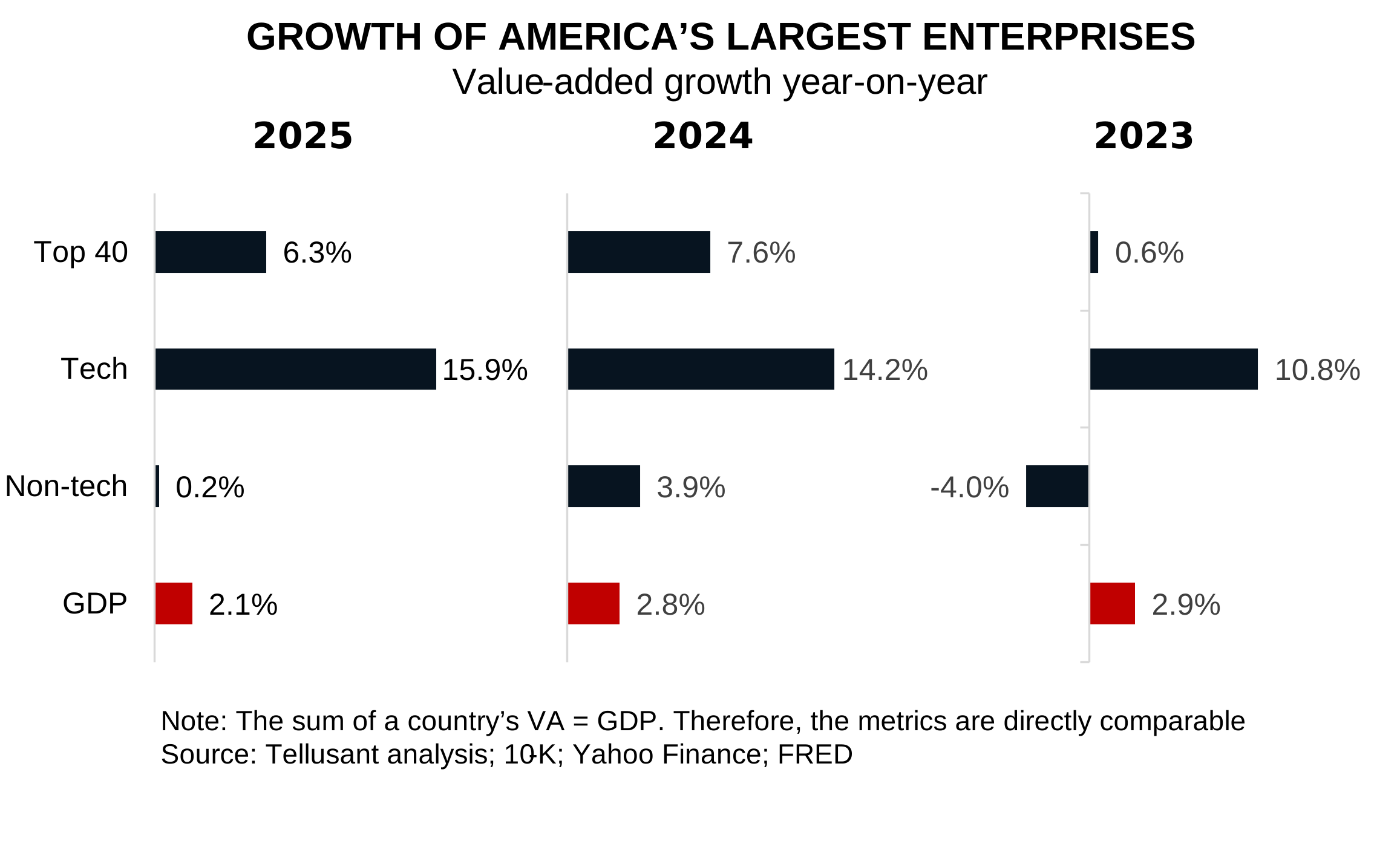
Below is a view of year-on-year growth for the 40 companies. Tech overwhelms non-tech. Since value-added is what makes up GDP (see Methods section, below), the growth of the companies can be directly compared to GDP.
Tech is what drives the U.S. economy. Non-tech is a drag on the economy.
Definitions
There are at least five ways to define corporate size:
Value-Added (VA) Assets (net operating assets) (number of) Employees Revenue Cash Flow (free cash flow)
The first three—VA, assets, employees—tell a size story. Revenue does not, while cash flow is too variable to be useful.
Why not revenue which is so often used? Consider the following example:
Let us say that you sell us a pen for 1 trillion and 1 dollars (1,000,000,000,001). We immediately sell it back to you for 1 trillion dollars.
You have suddenly created the world’s largest company by revenue (and we the second largest). Yet your value-added is only 1 dollar; not noteworthy.
If we were to merge our companies, what will the combined revenue be? 1 trillion and 1 dollars (1,000,000,000,001). Not 2 trillion and 1.
In real life, trading companies are close to the example: enormous revenue, little VA. Distributors are next, followed by retailers. Banks and biotech, on the other hand, have high VA relative to revenue.
In our analysis that resulted in the list of 40 the largest companies, CostCo has 13% VA as share of revenue. Morgan Stanley has the highest ratio at 87%. We call this density (see below).
Thus, revenue is a meaningless metric for comparing companies.
Methods
What is VA for a company? It is what is created internally. This is the sum of labor and capital that belong to the company. It excludes external purchases, which are VA of other companies. VA = revenue minus purchases = labor plus capital expenses (including tax payments). We call this General VA.
The sum of VA from companies and other entities in a country equals gross domestic product.¹
VA is the preferred size metric of governments and economists, who hardly look at revenue.
In our case, we use Specific VA. This differs from General VA by excluding non-asset specific activities. With this, VA equals operating profits plus operating expenses (with some adjustments). This in turn is gross profit in most cases.²
Specific VA = Operating profits + Operating expenses = Gross margin
120 companies were evaluated for calendar year 2025. If their fiscal year differ from calendar year³, we use the sum of the four calendar year quarters. If companies have off-quarter reporting⁴, we use the quarters closest to the calendar year (thus maximum one month off).
— — —
This concludes this year’s review of the largest companies. This is now an annual release by Tellusant.
¹ After deducting subsidies and adding taxes.
² There is much more to the analysis that is not reported here. E.g., Berkshire Hathaway has “investment and derivative contract gains” that are excluded. Financial institutions do not report in the fashion described but have corresponding data.
³ 9 of 120 companies
⁴ 22 of 120 companies
Source: Tellusant, Inc.